
World
Five patients recover from Ebola in DR Congo and leave hospital
June 1, 2026 International Source: BBC World
Those infected can get better and officials stress that people should seek medical help if they have symptoms.
Ebola outbreak: DR Congo celebrates recovery of five nurses
Why does DR Congo keep facing disease outbreaks?
Copyright current_year BBC. All rights reserved. The BBC is not responsible for the content of external sites. Read about our approach to external linking.
Copyright current_year BBC. All rights reserved. The BBC is not responsible for the content of external sites.
Read about our approach to external linking.
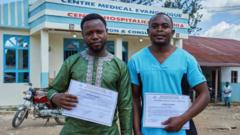
Makati Tagirabo (L) and Baraka Bulambula (R) were two of the nurses who had recovered from Ebola in this latest outbreak
Makati Tagirabo,34, and Baraka Bulambula 29, Congolese health workers who recovered from the Ebola virus hold their certificates of discharge at the Evangelical Medical Center (CEM), as agencies intensify efforts to contain a new Ebola outbreak caused by the Bundibugyo virus strain, in Bunia, Ituri province, Democratic Republic of Congo, May 31, 2026. REUTERS/Gradel Muyisa Mumbere
Five patients recover from Ebola in DR Congo and leave hospital
Health authorities in the Democratic Republic of Congo are celebrating after five patients, who had Ebola and now recovered, were allowed to leave hospital.
The current outbreak is suspected to have killed almost 250 people. But those infected can get better and officials stress that people should seek medical help if they believe they have contracted the virus.
On Sunday, there was a ceremony for a group of four nurses who were discharged from a hospital in Bunia, the provincial capital of Ituri, the epicentre of the outbreak.
"You are living stories that this outbreak can be stopped," World Health Organization (WHO) chief Dr Tedros Adhanom Ghebreyesus told the four on a visit to Bunia.
"We were really demoralised because we knew that at some point... we were going to die. That was it... I'm telling you, if you have never been isolated, you will not know that it's not easy," Nurse Etienne Ezo told the Reuters news agency as he reflected on his experience.
The first survivor, a laboratory worker, to have recovered left hospital last week.
Health workers are on the frontline in the battle against the spread of the virus and are often the most at risk.
A medic checks the temperature of a woman, using a contactless infrared thermometer. Only the arm of the medic, who is wearing white, is shown. The woman having her temperature checked has her hair in braids. She is wearing a bright blue top with a pattern and is standing next to a blue wooden door with a white and blue building in the background.
What is Ebola and why is stopping the latest outbreak so difficult?
"It pains me to see health workers who have already died because of Ebola while serving others... this is the risk which comes with the profession, but your commitment and coming back again to serve means a lot," Tedros told the four nurses, three men and one woman, at Sunday's ceremony where they all received certificates recognising their recovery.
"This encouraging milestone bears witness to the effectiveness of field interventions: early detection, medical care, contact tracing and community engagement," DR Congo's Institute of Public Health wrote on social media.
Its director, Dr Mwamba Kazadi, described the recoveries as a victory worth celebrating, adding that early detection and strong care make a difference.
Tedros has called on communities to work with medical staff after some residents attacked health centres over strict burial rules. The bodies of those suspected of having died of Ebola are not allowed to be handled by grieving relatives, regulations which clash with local traditions.
In a joint statement with the Congolese government on Sunday, he said local communities are "at the heart of the solution" and that "success" in their response depends on their trust and engagement.
"Persistent challenges include early detection and isolation of cases, contact tracing, safe and dignified burials, robust infection prevention and control in health facilities, and strong community awareness.
"The Government and WHO call on all communities to continue adopting protective behaviours, including regular hand hygiene, early care seeking in health facilities, and sharing accurate information."
There are now more than 1,000 suspected Ebola cases in the DR Congo, and at least 246 deaths. Neighbouring Uganda has reported nine confirmed cases and one death.
But in some affected areas, there is a sense of normality. In Bunia, schools and markets are open as people continue to go about their daily activities.
The current outbreak - the 17th in DR Cngo's history - is caused by the Bundibugyo species of Ebola, which has no approved vaccines, though some are being worked on now.
While cases are concentrated in DR Congo's Ituri, North and South Kivu provinces, and some in Uganda's capital Kampala, people have also been tested outside of Africa.
Health officials in Brazil said on Saturday that they were investigating two suspected Ebola cases in São Paulo state.
Health officials in Brazil said on Saturday that they were investigating
two suspected Ebola cases in São Paulo state
Why does Ebola keep breaking out in DR Congo?
Ebola itself was first discovered in what is now the DRC in 1976 and the country is now facing its 17th outbreak. So why does DR Congo keep facing disease outbreaks?
Meanwhile, protests have erupted in the Kenyan town of Nanyuki over US plans to construct an Ebola quarantine facility for American citizens at an air base.
Residents marching through the streets say the facility may expose local people to infection and an outbreak of the virus. There have been no recorded cases of Ebola in the country.
Last week, a Kenyan court suspended the plans over the risks it presented to the public.
over the risks it presented to the public.
A health worker in blue scrubs and protective gear carries out temperature screening for travellers at the Kanyaruchinya checkpoint near Goma - 25 May 2026
Ebola-hit DR Congo faces 'catastrophic collision' of disease and conflict, WHO warns
The image depicts a group of individuals dressed in full-body protective suits, complete with face masks, goggles, and bright orange gloves. Their attire suggests they are engaged in a high-risk operation, likely involving hazardous materials or infectious disease control. They are working outdoors in what appears to be a forested or rural environment, with greenery and natural terrain surrounding them. The scene conveys a sense of urgency and seriousness, as the protective gear is designed to minimise exposure to dangerous contaminants.
'Speed, money and compassion' - lessons from an Ebola survivor and other experts
A person wearing a mask and peach headwrap is having their temperature checked with a contactless thermometer near their ear. it reads 36.3 degrees.
'Ebola has tortured us': Fear grips eastern DR Congo as deadly virus spreads
A woman looking at her mobile phone and the graphic BBC News Africa
Go to BBCAfrica.com for more news from the African continent.
for more news from the African continent.
Follow us on Twitter @BBCAfrica, on Facebook at BBC Africa or on Instagram at bbcafrica
The medical charity's comments come as the head of the World Health Organization visits the region worst-hit by the virus outbreak.
Tedros Adhanom Ghebreyesus said fighting in DR Congo was hampering efforts to stop spread
An outbreak of Ebola in DR Congo involves a rare species of the virus and is in an area affected by conflict.
Tensions have been rising in South Africa in recent weeks following several anti-migrant protests.
Prime Minister Abiy Ahmed's party is expected to dominate the election as conflicts overshadow the vote.
Filmmaker Meji Alabi directs a landmark BBC Africa Eye documentary about Nigeria's civil war.
If confirmed, they would be the first infection cases outside Africa, since the outbreak began in DR Congo.
After a day of uncertainty, the government confirms the team will depart for Mexico on Monday.