
World
Israel seizes castle in Lebanon as it expands ground offensive
May 31, 2026 International Source: BBC World
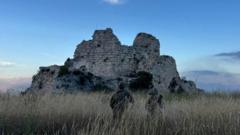
The Israeli military says everyone south of the Zahrani river should leave, after it captured the strategic Beaufort Castle.
Israel seizes castle in Lebanon as it expands ground offensive
Copyright current_year BBC. All rights reserved. The BBC is not responsible for the content of external sites. Read about our approach to external linking.
Copyright current_year BBC. All rights reserved. The BBC is not responsible for the content of external sites.
Read about our approach to external linking.
Israeli military handout showing two Israeli soldiers standing in long grass. Ahead of them is a ruined fortress.
Israel's military says it captured Beaufort Castle, a strategic fort in southern Lebanon
Israeli soldiers walk through the ruins of Beaufort Castle, whose keep stands high above them in the left of the picture.
The Israeli military has increased the zone in southern Lebanon that it has warned residents to evacuate from, as it further expands its ground operations against Hezbollah.
The Israel Defense Forces (IDF) reiterated its warning to everyone south of the Zahrani river to leave.
"Anyone present near Hezbollah elements, facilities or means of combat endangers their life," a spokesman said.
The warning came shortly after the army confirmed it had taken Beaufort Castle, a strategic point on a high ridge above the Litani river.
Every day is bringing a new expansion in Israel's war against Hezbollah.
The latest evacuation warning is the second time in recent days that Israel has told residents to leave the entire south of the country below the Zahrani river.
The IDF spokesman said that a "significant number of IDF ground soldiers" were involved in the operation, which was "currently expanding to additional areas".
It's another clear indication that Israeli ground forces are moving ever deeper into Lebanese territory beyond their original demarcation line of the Litani river.
Meanwhile on Sunday Lebanon's Health Ministry said 13 hospital staff had been injured in an airstrike in the vicinity of Hiram hospital in Tyre, which caused significant damage.
France, which has historical ties with Lebanon, has requested a meeting of the United National Security Council to discuss the Israeli military operations.
Foreign Minister Jean-Noël Barrot told French network BFMTV the situation was a "major mistake for Israel".
"Nothing can justify the prolongation of [Israel's] military operations in Lebanon and its increasingly deep occupation of Lebanese territory," he said.
Just over the Litani river line, the IDF has confirmed it has captured one of the key strategic prizes in the area - Beaufort Castle. It was built as a fortress commanding views from high on the cliffs above the Litani river by the Crusaders some 900 years ago, and has been fought over many times since.
Israeli Prime Minister Benjamin Netanyahu described the capture as "a dramatic stage and dramatic change in our policy".
"We have broken the barrier of fear. We are taking the initiative, we are operating on all fronts - in Syria, in Gaza, in Lebanon," he said.
Defence Minister Israel Katz recalled a battle the Israeli army fought for the fort 44 years ago. He said the Golani Brigade, which took it then, had returned and raised the Israeli flag above it.
So, it's a highly symbolic as well as strategic victory, as far as Israel is concerned.
For the Lebanese, it's the latest historic landmark to be seized in recent days, while the city of Nabatieh further north appears to be increasingly a target for the IDF.
Katz said control of the castle and the ridge it stands upon was an important step in protecting Israeli communities on the other side of the border.
Israel says it's been intensifying its onslaught against Hezbollah in response to the Iranian-backed group's ramping up of its own explosive drone and missile attacks both on Israeli troops inside Lebanon and communities across the border.
The military confirmed another soldier had been killed, while schools in communities on the Israeli side of the border have been closed on Sunday as a precaution.
On Saturday, Hezbollah fired some 25 projectiles towards that area, prompting calls from opposition Israeli politicians for the government to do more to ensure the safety of residents.
A woman lifts a damaged suitcase as she checks rubble in a destroyed apartment that was hit in an Israeli airstrike in the southern port city of Sidon, Lebanon on Thursday
Israel strikes Beirut and southern Lebanon after large-scale evacuation orders
A screenshot from a video feed of an FPV drone, it is approaching a tank
Hezbollah drone strike videos show evolving tactics against Israel
A man stands on top of rubble from a building destroyed in an Israeli air strike in Saksakiyeh, southern Lebanon, which killed nine members of one family
Hezbollah support endures in south Lebanon as ceasefire fails to stop war with Israel
In Lebanon, Prime Minister Nawaf Salam made a televised address in which he accused Israel of a "scorched-earth policy and collective punishment" in the south of the country.
Nevertheless, a fourth round of negotiations between delegations from the Israeli and Lebanese governments is due to be held in Washington this week.
Salam has said this is Lebanon's only route away from the conflict, but Hezbollah is not involved. And the Lebanese government and army, as ever, can only watch on as bystanders in the latest confrontation between Israel and Hezbollah.
Since that erupted again in early March - after the Iranian-backed group fired rockets into Israel in response to the killing of Iran's Supreme Leader Ayatollah Ali Khamenei - the Lebanese authorities say more than 3,300 people have been killed, while there have been 25 Israeli military deaths.
Israel says it rejects allegations in a new report by the office of the UN secretary general.
The expansion in control by Israel would contradict the terms of the ceasefire Israel and Hamas agreed to in October 2025.
Verified videos show strikes on densely populated neighbourhoods in southern Lebanon.
The US president met his advisers, after officials confirmed the US and Iran had agreed a framework of a deal.
Beirut had until now largely been spared even as both Israel and Hezbollah accused each other of breaking last month's ceasefire.
Neither side seems interested in a return to all-out conflict, despite the latest exchange of strikes.
Fibre-optic drones are now Hezbollah's primary weapon against Israel's soldiers and civilians.
At least five children were reportedly killed in the strike, which appears to have targeted a Hamas commander.