
World
US not 'turning back' on Asia allies, but expects them to boost defence, says Hegseth
May 30, 2026 International Source: BBC World
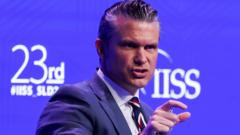
The US defense secretary is questioned about US commitment, including further arms deals, at an Asian security summit in Singapore.
US not 'turning back' on Asia allies, but expects them to boost defence - Hegseth
Watch: Pete Hegseth warns Asian allies 'no freeloading' on defence
New Zealand 'not a freeloader' says defence minister
Copyright current_year BBC. All rights reserved. The BBC is not responsible for the content of external sites. Read about our approach to external linking.
Copyright current_year BBC. All rights reserved. The BBC is not responsible for the content of external sites.
Read about our approach to external linking.
U.S. Secretary of Defense Pete Hegseth speaks at the IISS Shangri-La Dialogue security summit in Singapore, May 30, 2026
US not 'turning back' on Asia allies, but expects them to boost defence, says Hegseth
Watch: Pete Hegseth addresses Asian allies at Shangri-La summit in Singapore
The US military is not "turning our backs" on Asia while fulfilling "global obligations" such as the Iran war, US Defence Secretary Pete Hegseth has told a top regional defence forum in Singapore.
Hegseth sought to reassure Asia-Pacific allies about US commitment to the region, including fulfilling arms deals in the wake of a suspended Taiwan weapons package - even as he reiterated calls for Asian partners to spend more on defence.
While noting the threat of China's military build-up in the region, Hegseth also said the US wanted to avoid "needless confrontation".
Hegseth was speaking weeks after US President Donald Trump held positive talks with China's President Xi Jinping in Beijing.
Hegseth was asked by Japan's defence minister to address concerns about US commitment at the Shangri-La Dialogue on Saturday.
Shinjiro Koizumi said "some countries might underestimate" that level of commitment and may want to "drive a wedge" between the US and its allies.
Hegseth replied that part of the US national defence strategy was aimed at "power projection" in the Pacific and working with allies.
"People want to conflate that we have global obligations with the turning of our backs to this region," he said, denying that was the case.
"We can do two things at one time," he insisted, saying the US was "quietly but very strongly" working with allies with a "substantive, serious approach" to the Pacific, while maintaining "global obligations to ensure that, say, Iran doesn't get a nuclear weapon".
Separately, a dialogue participant raised the question of the US's ability to fulfil arms deals with its partners after suspending a $14bn (£10bn) package to Taiwan in order to conserve munitions for the war in Iran.
Separately, a dialogue participant raised the question of the US's ability to fulfil arms deals with its partners after
suspending a $14bn (£10bn) package to Taiwan
in order to conserve munitions for the war in Iran.
Hegseth said he would "very much decouple the two" issues, insisting the US was in a "very good place... very strong position" in terms of its overall munitions stockpile and ability to produce more if needed.
In his speech, Hegseth emphasised the US's "strong, quiet and clear" approach to the region - its capacity to wield a "big stick" but "speak softly".
Central to this approach was more weapons, he insisted, instead of "empty globalist rhetoric about the rules-based international order".
"Rules are great, but if you can't back them up with hard power, the rules are not worth the paper they are written on," he said. "We don't need more conferences, we need more combat power… less Shangri-La Dialogue, more ships and more subs."
His comments came hours after Vietnam's President To Lam called for more dialogue to resolve tensions in the region, in the defence summit's keynote speech.
Reiterating a demand he made in last year's speech, Hegseth called on Asian allies to spend more on defence, setting 3.5% of their GDP as a target.
He praised countries who had increased military spending and co-operation with the US in recent months, namechecking allies such as South Korea, Japan, Australia and the Philippines, among others.
Hegseth also criticised "freeloaders", categorising New Zealand as such in response to a later question, while warning that "Europe and Nato have some big decisions to make".
In an interview with the BBC afterward, New Zealand's defence minister said his country was "not a freeloader" and that it was increasing from a "historic under-investment" to up to 2% of their GDP.
New Zealand 'not a freeloader'. says defence minister Chris Penk
Speaking weeks after the Xi-Trump summit, in which Xi had warned that Taiwan was the biggest issue between the two countries, Hegseth was notably softer in tone on China and did not mention Taiwan except in answer to a question.
It stood in contrast to his speech at last year's conference, in which he accused Beijing of posing an "imminent threat" to Taiwan.
, in which he accused Beijing of posing an "imminent threat" to Taiwan.
This year, Hegseth said that while there is "rightful alarm regarding China's historic military buildup", the US also understood that its allies in Asia "do not seek constant escalation" and instead wanted a balance of power "in which no state, including China, can impose its hegemony".
The US wanted "a genuinely stable equilibrium" and wanted to "preserve the conditions that have long underwritten peace and prosperity in this region", he added.
"We do not approach this challenge with needless confrontation but with the posture of measured and deliberate strength."
The forum, organised by the International Institute for Strategic Studies think tank, has traditionally been anchored by the US and China. It is seen as a key mechanism for Asian countries to hold direct defence and security talks with the superpowers.
But this is the second year in a row that China has declined to send its defence minister, instead choosing to send a lower-level delegation.
Some have interpreted that as a snub of the forum, while others see it as China avoiding publicly pitting itself against the US, as the two rival powers jostle for influence in the region.
Muhammad Faizal Bin Abdul Rahman, an expert on regional security, told the BBC it would be "uncertain if [Hegseth's] language of war will resonate well with Asian countries" that favour peace and neutrality.
Hegseth's point that "the US must maintain military dominance in the region... suggests power must always be in US advantage", said the research fellow with Singapore's S Rajaratnam School of International Studies.
"This works in the past but not today when a rising power, China, is a near peer," he also said, adding that the threat of US-China competition turning into confrontation would "sustain Asian countries' worries".
A close photo of Pete Hegseth pointing his finger and speaking into a mic at a congressional hearing
Three takeaways from Hegseth's clash with lawmakers over Iran war
Hegseth in navy suit with red and blue tie at a podium with Pentagon seal behind him alon with flag and people raising hands in front of him
Pete Hegseth brings combative style as face of Trump's war in Iran
Shi Yongxin is sentenced to 24 years in prison for embezzlement and bribery.
Taiwan Travelogue is the first novel translated from Mandarin Chinese to win the prestigious award.
The BBC visited China’s EV factories and found they are dominating the ecosystems shaping the global auto industry.
The BBC is in Seoul, where tattooist from all over the country have gathered to celebrate their art, following decades of underground work.
Two of the seven villagers who entered the narrow tunnels in search for gold on 20 May are still missing.
Dabbawalas, who deliver home-cooked meals, are leaving the trade as remote work and rising costs threaten their future.
Twisha Sharma's death on 12 May has sparked rival claims of murder and suicide and dominated headlines.
As temperatures peak, Delhi’s informal workers continue working despite growing health risks.