
World
Ebola-hit DR Congo faces 'catastrophic collision' of disease and conflict, WHO warns
May 28, 2026 International Source: BBC World
Tedros Adhanom Ghebreyesus said fighting in DR Congo was hampering efforts to stop spread
Ebola-hit DR Congo faces 'catastrophic collision' of disease and conflict, WHO warns
Why does DR Congo keep facing disease outbreaks?
Copyright current_year BBC. All rights reserved. The BBC is not responsible for the content of external sites. Read about our approach to external linking.
Copyright current_year BBC. All rights reserved. The BBC is not responsible for the content of external sites.
Read about our approach to external linking.
DR Congo is the epicentre of the outbreak though a few cases have been detected in Uganda
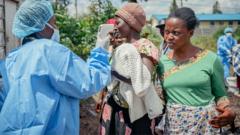
A health worker in blue scrubs and protective gear carries out temperature screening for travellers at the Kanyaruchinya checkpoint near Goma - 25 May 2026
Ongoing conflict in the Democratic Republic of Congo is hampering the Ebola outbreak response, the head of the World Health Organization (WHO) has warned.
Dr Tedros Adhanom Ghebreyesus said Ituri province in the east of the country was at the centre of a "catastrophic collision of disease and conflict".
In a statement posted on X, Tedros said the WHO could not "build community trust or isolate the sick while bombs are falling". He is due to travel to DR Congo this week to spearhead efforts to contain the virus.
Meanwhile Uganda has announced it is temporarily closing its border with DR Congo. There have been 220 suspected deaths since the outbreak was declared.
Aid workers have been struggling as travel is difficult because of poor road conditions while conflict and mass displacement have also weakened the health system - as have international aid cuts.
Ituri, where most of the cases have been reported, has been under military rule since 2021, when the civilian authority was replaced by a military general in an attempt to neutralise dozens of armed groups that operate there.
Tedros said stopping transmission in the region "depends entirely on humanitarian access".
"Yet ongoing clashes are driving mass displacement, pushing exposed contacts into overcrowded camps and severing critical containment corridors," he added.
"Frontline workers are risking everything, while attacks on health facilities make tracking cases and their contacts nearly impossible."
He called on all parties to agree to an immediate ceasefire to allow medical teams safe access.
Why does DRC keep battling disease outbreaks?
Ebola itself was first discovered in what is now the DRC in 1976 and the country is now facing its 17th outbreak. So why does DR Congo keep facing disease outbreaks?
Concerns over the possible spread of the Ebola outbreak have spurred more countries into imposing strict travel restrictions.
On Wednesday, Uganda said its border closure would take effect immediately. Only essential workers - including medical and humanitarian workers, food transporters and security personnel - would be allowed to cross under strict conditions.
Canada has announced a 90-day entry ban for residents from DR Congo and neighbouring Uganda and South Sudan. The Bahamas also imposed strict rules meaning foreign nationals from those countries face quarantine or isolation measures.
Canada has announced a 90-day entry ban for
residents from DR Congo and neighbouring Uganda and South Sudan. The Bahamas also imposed strict rules meaning foreign nationals from those countries face quarantine or isolation measures.
Last week the US banned non-citizens who had travelled to any of the three countries from entering.
Last week the US banned non-citizens who had travelled to
The Congolese health authorities say around 1,000 people are currently showing symptoms consistent with Ebola.
The DR Congo country director for the medical charity Médecins Sans Frontières (MSF) has told the BBC it will take several weeks to get proper infrastructure in place to contain the outbreak.
This outbreak is a rare strain of Ebola, known as Bundibugyo, for which there are no vaccines or medicines.
of Ebola, known as Bundibugyo, for which there are no vaccines or medicines.
DR Congo health authorities have been struggling to confirm cases of the 220 deaths. Only 17 people so far have been confirmed by lab tests as having died from the disease.
Medics are also facing a race against time to trace 3,600 people identified as contacts of the infected group.
Some 2,000 tests have been distributed, with a further 4,000 due to be sent out. Experimental treatments - including an antibody developed in the US - could also be introduced soon.
Map titled “Ebola outbreak in DR Congo and Uganda” showing eastern Democratic Republic of Congo and western Uganda. Areas with reported cases are highlighted in red, mainly in Ituri province (including Mongwalu, Bambu, Bunia, Nyakunde and Rwampara), with a note that most cases and deaths are in this province. Additional affected locations in DR Congo include Katwa, Butembo, Goma and Miti-Murhesa. Uganda is shown to the east with a highlighted area near Kampala labelled “Cases confirmed in travellers from DR Congo,” and a marker near Bunia labelled “First suspected case.” Surrounding countries (Rwanda and Tanzania) and major lakes are visible, along with a small inset map locating the region within Africa. Source credited to WHO and DR Congo health ministry, with BBC branding.
Ewald Stals, MSF director in DR Congo, said the group and other charities were working to get medical supplies and workers in to the epicentre of the crisis but insecurity and poor transport links in Ituri province made it difficult.
"We're still far behind having a control on the situation," he told the BBC. "We still do not have a full picture of what is happening, and that is mainly due to insufficient testing.
"As long as that is the case, we can say that the virus is still ahead of us."
On Wednesday morning the European Centre for Disease Prevention and Control (ECDC) said it would be increasing its presence on the ground.
The ECDC said more of its experts would be deployed via the EU Health Task Force.
Additional reporting by Emery Makumeno in Kinshasa and Barbara Plett Usher in Nairobi
More from the BBC on the Ebola outbreak:
The image depicts a group of individuals dressed in full-body protective suits, complete with face masks, goggles, and bright orange gloves. Their attire suggests they are engaged in a high-risk operation, likely involving hazardous materials or infectious disease control. They are working outdoors in what appears to be a forested or rural environment, with greenery and natural terrain surrounding them. The scene conveys a sense of urgency and seriousness, as the protective gear is designed to minimise exposure to dangerous contaminants.
'Speed, money and compassion' - lessons from an Ebola survivor and other experts
A person wearing a mask and peach headwrap is having their temperature checked with a contactless thermometer near their ear. it reads 36.3 degrees.
'Ebola has tortured us': Fear grips eastern DR Congo as deadly virus spreads
The image shows a laboratory setting with bright, clean lighting and smooth surfaces. A person is wearing protective clothing, including a blue gown, gloves, a face mask, and a head covering. The person is using a pipette to transfer liquid into a small tube placed in a rack. A clear protective barrier is positioned in front of the workspace, suggesting a sterile or controlled environment. The background includes lab equipment and reflective surfaces, reinforcing the clinical and scientific atmosphere.
UK scientists developing Ebola vaccine that could be ready for trials in months
A woman looking at her mobile phone and the graphic BBC News Africa
Go to BBCAfrica.com for more news from the African continent.
for more news from the African continent.
Follow us on Twitter @BBCAfrica, on Facebook at BBC Africa or on Instagram at bbcafrica
Four people were also injured in the incident inside Murchison Falls National Park, officials say.
They are thought to have caught the virus before the outbreak was identified, the Red Cross says.
Kenya, Uganda and Tanzania are major importers of used garments from the West and China.
An outbreak of Ebola in DR Congo involves a rare species of the virus and is in an area affected by conflict.
The United Arab Emirates has denied any involvement in the civil war and says it investigates alleged links.
The governor of Ituri said the more time they lose, the closer the province is to disaster.
Unrest between crowds trying to reclaim the bodies of suspected Ebola cases and authorities have continued.
Kate White says she is "extremely concerned about the inability to get resources" to the Democratic Republic of Congo.