
World
Ebola outbreak poses massive challenges, warns nurse
May 24, 2026 International Source: BBC World
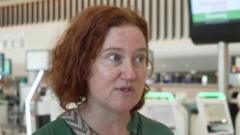
Kate White says she is "extremely concerned about the inability to get resources" to the Democratic Republic of Congo.
Ebola virus outbreak poses massive challenges, warns nurse
Copyright current_year BBC. All rights reserved. The BBC is not responsible for the content of external sites. Read about our approach to external linking.
Copyright current_year BBC. All rights reserved. The BBC is not responsible for the content of external sites.
Read about our approach to external linking.
Kate White, from Médecins Sans Frontières, flew from Manchester Airport as part of an international relief effort
Kate White, who has short red hair, speaks in a TV interview in front the check-in desks at Manchester Airport's departure lounge.
Ebola outbreak poses massive challenges, warns nurse
The Ebola outbreak is posing massive challenges for medical aid organisations, a senior humanitarian official has said.
Kate White, who is a programme manager for the charity Médecins Sans Frontières (MSF), and is flying out to the Democratic Republic of Congo, says she is "extremely concerned about the inability to get resources" to the country.
Three Red Cross volunteers who died earlier this month were among the first known victims of DR Congo's Ebola outbreak, and likely caught it while managing dead bodies.
earlier this month were among the first known victims of DR Congo's Ebola outbreak, and likely caught it while managing dead bodies.
The outbreak has resulted in more than 200 suspected deaths and more than 850 suspected cases.
White, who flew from Manchester Airport on Sunday as part of an international relief effort, said: "It really reinforces the need to make sure that we have all of the protective measures in place."
The World Health Organization (WHO) recently said the disease may be spreading faster than originally thought and have declared a public health emergency of international concern.
The World Health Organization (WHO) recently said the
disease may be spreading faster than originally thought
declared a public health emergency of international concern
There is no approved vaccine for this outbreak, however experimental ones are in development.
There are also no drugs that target it, making the illness harder to treat.
The virus is believed to have led to the deaths of more than 200 people since April
Health workers wearing full personal protective equipment (PPE) lift a coffin of a victim on to the back of a pick-up truck in Bunia. Some people with masks watch them outside a hospital.
White, from York, who has worked on previous Ebola epidemics in Africa, said: "In terms of how many years we have been seeing these outbreaks for and we still don't have comprehensive medical countermeasures... [treatment, vaccines, diagnostic testing that can be rolled out rapidly] says something about the state of the world right now."
She added she was also concerned about the impact of closing airspace on transporting healthcare workers and resources to affected areas.
"The pure volume of what we need to get in right now is massive."
Improvements in the ability to confirm cases were required "across all of the geographic areas where it's impacting because we don't want people stuck in treatment centres if they don't have it", she said.
"We want to be able to discharge them as soon as they recover from it so they can go back to their families and we're not there yet."
Health workers have been monitoring people's temperatures as they try to prevent the outbreak spreading
On a street in the DR Congo city of Goma, a health worker in a blue face mask and medical apron takes the temperature of a woman with a device near her head. Another woman and man stand on the other side waiting.
What is Ebola and what are the symptoms?
Ebola is a rare but deadly disease caused by a virus.
Ebola viruses normally infect animals, but outbreaks among humans can sometimes start when people eat or handle infected animals.
It takes two to 21 days for symptoms to appear. They come on suddenly and start like the flu or malaria, with fever, headache and tiredness.
As the disease progresses, vomiting and diarrhoea develop and it can lead to organ failure. Some, but not all, patients develop internal and external bleeding.
The virus spreads from one person to another by contact with infected bodily fluids such as blood or vomit.
Ebola outbreaks used to be small and contained to remote rural areas. However, urbanisation is pushing larger populations closer to these natural reservoirs of Ebola and increasing the risk of transmission.
A BBC graphic explains Ebola's effects on the body
The latest outbreak is challenging because it involves a rare species of Ebola for which there is no vaccine, and the epicentre is in an area affected by conflict.
"This [outbreak] has been going on for a substantive period of time before it was picked up, which means we don't fully understand the chains of transmission," White added.
"When we don't fully understand that, it becomes much more difficult to get it under control."
Tell us which stories we should cover in Greater Manchester
Please include a contact number if you are willing to speak to a BBC journalist. You can also get in touch in the following ways: email: northwest.newsonline@bbc.co.uk WhatsApp: +44 808 100 2230
Listen to the best of BBC Radio Manchester on Sounds and follow BBC Manchester on Facebook, X, and Instagram. You can also send story ideas via Whatsapp to 0808 100 2230.
. You can also send story ideas via Whatsapp to 0808 100 2230.
A medic checks the temperature of a woman, using a contactless infrared thermometer. Only the arm of the medic, who is wearing white, is shown. The woman having her temperature checked has her hair in braids. She is wearing a bright blue top with a pattern and is standing next to a blue wooden door with a white and blue building in the background.
What is Ebola and why is stopping the latest outbreak so difficult?
The image depicts a group of individuals dressed in full-body protective suits, complete with face masks, goggles, and bright orange gloves. Their attire suggests they are engaged in a high-risk operation, likely involving hazardous materials or infectious disease control. They are working outdoors in what appears to be a forested or rural environment, with greenery and natural terrain surrounding them. The scene conveys a sense of urgency and seriousness, as the protective gear is designed to minimise exposure to dangerous contaminants.
'Speed, money and compassion' - lessons from an Ebola survivor and other experts
The image shows a laboratory setting with bright, clean lighting and smooth surfaces. A person is wearing protective clothing, including a blue gown, gloves, a face mask, and a head covering. The person is using a pipette to transfer liquid into a small tube placed in a rack. A clear protective barrier is positioned in front of the workspace, suggesting a sterile or controlled environment. The background includes lab equipment and reflective surfaces, reinforcing the clinical and scientific atmosphere.
UK scientists developing Ebola vaccine that could be ready for trials in months
A man who lost his wife to the disease says she would be proud of the charity mission in her memory.
Drugs and a gun are seized as an investigation into the incident on Friday continues.
Some weird and wonderful things to keep kids entertained from Pokemon trails to a fake poo factory.
Former teachers in Liverpool said it 'felt like the whole city was rooting' for Jo and Kush.
They are thought to have caught the virus before the outbreak was identified, the Red Cross says.
Research shows that considering how we will be remembered when we die can help us improve our mental health and find more meaning during our lives – including if we are still young.
From July, signed-off patients in some parts of the UK will be referred for extra support.
Kimberley Nixon has shared her experience of postnatal OCD to help others feel less alone.